Choose timezone
Your profile timezone:
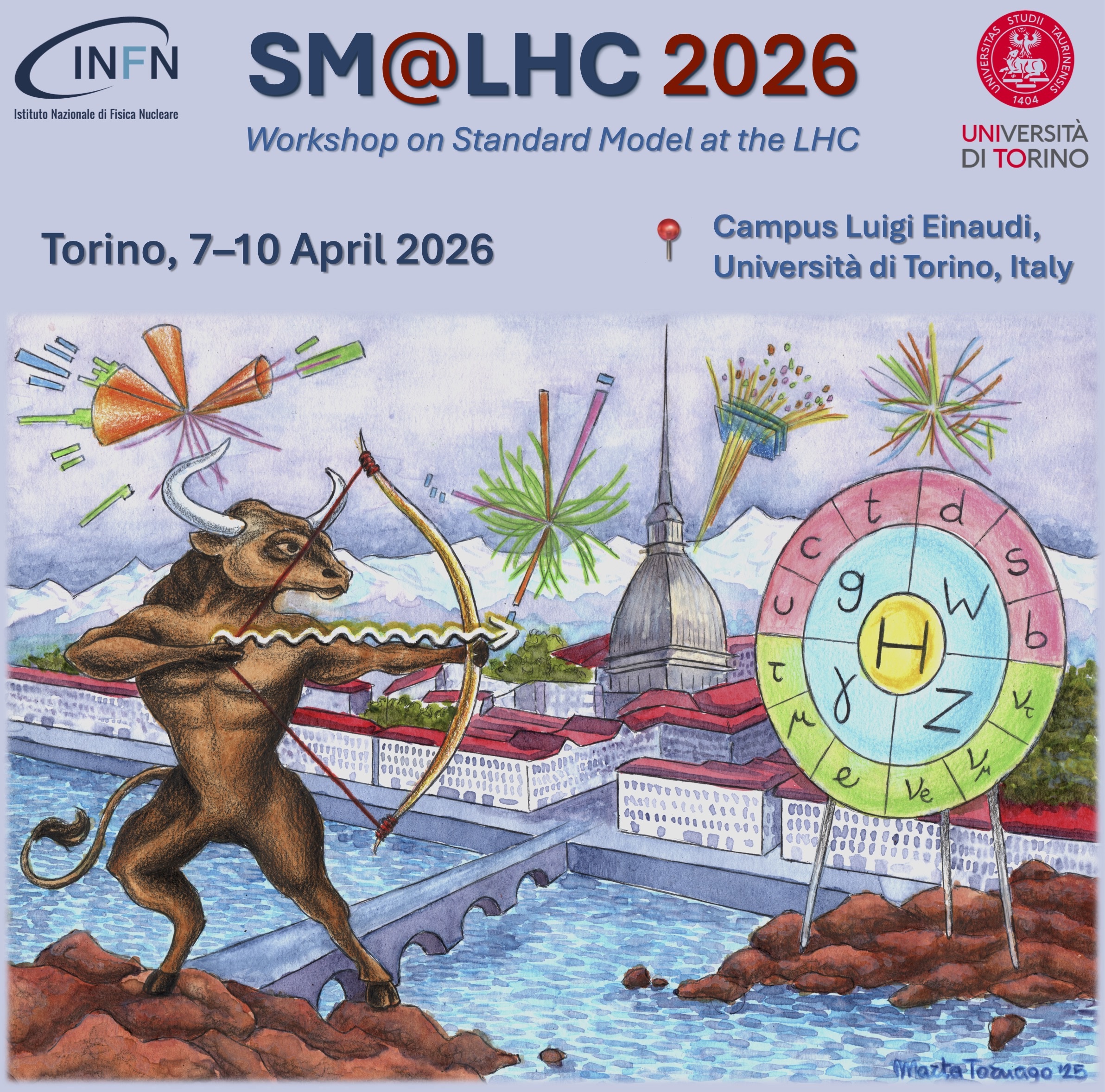
The SM@LHC Workshop brings together theorists and experimenters to discuss the latest developments and future prospects in Standard Model phenomenology at the Large Hadron Collider, with emphasis on topical aspects at the interface between theory and experiment. The workshop has sessions devoted to Electroweak, QCD, Higgs, Top, Heavy Flavour and EFT.
The 2026 edition will be hosted by the University of Torino and INFN at Campus Luigi Einaudi in Torino, Italy.
NEW: The early registration fee has been extended. With a payment by 10th March 2026 is 250 euros. From 11th March onwards, the regular fee is 300 euros.
NEW: The call for abstracts of Early-stage Researcher Talks is closed. They will be reviewed by conveners, and, if accepted, included in the plenary program.
Previous workshops of the SM@LHC series took place in Durham (SM@LHC 2025) Rome (SM@LHC 2024), FNAL (SM@LHC 2023), CERN (SM@LHC 2022), Online (SM@LHC 2021), Zurich (SM@LHC 2019), Berlin (SM@LHC 2018), Amsterdam (SM@LHC 2017), Pittsburgh (SM@LHC 2016), Florence (SM@LHC 2015), Madrid (SM@LHC 2014), Freiburg (SM@LHC 2013), Copenhagen (SM@LHC 2012), Durham (SM@LHC 2011) and London (SM@LHC 2009).
International Organizing Committee:
Local Organizing Committee:
To search for physics beyond the Standard Model (BSM) some of the most promising and sensitive observables are constituted by flavour-changing neutral-current $B$-meson decays mediated by $b \to s \ell\ell$ transitions. While several hints for deviations from the Standard Model have emerged over the recent years, it has also become clear that a more thorough theoretical understanding of non-local charm-loop effects, possibly mimicking BSM physics, is mandatory to turn these hints into robust results. To achieve this, experimental inputs can be combined with the fundamental principles of unitarity and analyticity via dispersive techniques to constrain the non-local hadronic form factors as tightly as possible. In our work we demonstrate that the expected analytic structures of these form factors, in particular including anomalous thresholds, can also be found in and matched onto perturbative partonic calculations. This further justifies the use of quark–hadron duality to provide additional theoretical constraints.
On site
Single Higgs properties and Higgs potential
This contribution will present recent theory developments in Higgs boson production, in particular quark mass effects in Higgs production in gluon fusion. The impact of top-, bottom- and charm quark masses will be discussed, both in the on-shell and in the MSbar scheme. Furthermore, alternative treatments of quark masses, in particular in the four-flavour scheme, will be studied. (20' presentation + 5' discussion)
The contribution will present recent theory developments related to precision calculations for Higgs boson pair production. In particular, it will give an update about the calculation of electroweak corrections to HH production in gluon fusion and about efforts to reduce the uncertainties related to the top quark mass scheme. (20' presentation + 5' discussion)
The contribution will present updated constraints on Higgs self-interactions obtained by ATLAS and CMS from Run-3 data and combined Run-2 HH measurements, including their interplay with single-Higgs results, highlighting the progressive improvement in HH sensitivity achieved by both collaborations. The current status and future sensitivity to triple-Higgs production will be reviewed, together with the most recent HL-LHC projections for HH and HHH and the resulting expected precision on the Higgs self-couplings. (20' presentation + 5' discussion, ATLAS/CMS shared material)
Higgs boson production in association with jets is a key process for precision tests of the Standard Model, particularly in the phase-space region selected by Vector Boson Fusion-type cuts, where large hierarchies between invariant masses and transverse momenta arise.
In this kinematic regime, fixed-order perturbative predictions become insufficient and all-order resummation of high-energy logarithms is required.
We investigate Higgs plus jets production within the High Energy Jets (HEJ) framework, which provides a systematic resummation of such logarithmic contributions.
We present novel results for Higgs production in association with a quark-antiquark pair. This process constitutes a relevant background to di-Higgs searches, and its accurate theoretical description is essential to reduce uncertainties in Higgs-sector measurements at the High-Luminosity LHC.
Finally, we assess the impact of the resummation of Higgs plus quark-antiquark production -- relevant at next-to-leading logarithmic accuracy -- on Higgs plus jets observables. (12' presentation + 3' discussion)
One of the key goals of the LHC physics program is the precise determination of the Higgs boson couplings to fermions across all generations. While couplings to third-generation fermions have been established, those to light quarks remain largely unconstrained. Rare exclusive radiative decays of the Higgs boson, such as $H\to\rho/\phi/K^{*0}+\gamma$, provide a unique and direct probe of the Yukawa couplings to the $u$, $d$, and $s$ quarks, as well as sensitivity to possible physics beyond the Standard Model that could enhance these processes. Using the full Run-2 dataset collected by the CMS experiment, searches for the decays $H\to\rho/\phi/K^{*0}+\gamma$ have been performed, targeting final states with a high-energy photon and a light vector meson reconstructed from charged hadrons. These analyses face significant experimental challenges due to the extremely small expected branching fractions and the presence of large backgrounds. Sensitivity is enhanced by combining multiple Higgs boson production modes and by exploiting the distinctive kinematic and topological properties of the exclusive final states. (12' presentation + 3' discussion)
Gluon-induced production of a Higgs boson in association with a Z-boson is an important Higgs production channel at the LHC. Precise theoretical predictions for this channel are therefore required, both within the Standard Model and beyond. Effects beyond the SM can be parametrised using the Standard Model Effective Field Theory (SMEFT).
In this talk, we present the NLO QCD predictions for $gg \to ZH$ including fully analytic top-mass-dependence. We incorporate the leading dimension-six SMEFT operators relevant for this process. We study their phenomenological impact and the interplay of the Wilson coefficients, based on an implementation in Powheg-Box-V2.
Indirect searches for new physics at the LHC increasingly rely on precision measurements in the high-energy tails of kinematic distributions, where uncertainties from Parton Distribution Functions (PDFs) are often a bottleneck. In this talk, I study the interplay between PDFs and Standard Model Effective Field Theory (SMEFT) interpretations in two key LHC sectors: Drell–Yan and top-quark production.
I compare two complementary strategies for robust PDF determination for new-physics searches: (i) simultaneous fits of PDFs and SMEFT Wilson coefficients, and (ii) sequential fits based on an initial conservative PDF determination using observables that can be reliably assumed to be SM-like. Both approaches are assessed through controlled closure tests in a realistic High-Luminosity LHC scenario.
I show how different fitting strategies impact PDFs determination and SMEFT constraints and propose concrete best-practice recommendations for robust new-physics searches at the LHC.
A search for the rare B_(s)^0 \to \mu^+ \mu^- \mu^+ \mu^- decays is presented using proton-proton collision data collected by the CMS experiment at \sqrt{s} = 13.6 TeV between 2022 and 2024, corresponding to an integrated luminosity of 170 fb^{-1}. These Cabibbo-suppressed flavor-changing neutral current processes are highly suppressed in the Standard Model and are sensitive to potential new physics contributions in short-distance b \to s\ell^+\ell^- transitions.
Signal candidates are reconstructed in fully identified four-muon final states and normalized to the kinematically similar B_s^0 \to J/\psi(\mu^+\mu^-)\,\phi(\mu^+\mu^-) decay. A combination of optimized selections on muon quality, vertexing, and kinematics, together with machine learning classifiers, is employed to efficiently suppress combinatorial background while maintaining high signal efficiency.
No significant excess above the expected background is observed, and upper limits are set on the corresponding branching fractions, representing the most stringent constraints to date and providing a solid basis for future studies aimed at further constraining the Wilson coefficients governing b \to s \ell^+\ell^- transitions.
Single Higgs properties and Higgs potential
This contribution will review various ways that have been suggested to constrain light quark Yukawa couplings, for example through off-shell measurements of Higgs production or through Higgs+charm production. In addition, it will give an update about calculations that address constraints on the top-Yukawa coupling and CP-properties. (20' presentation + 5' discussion)
The discovery of the Higgs boson ten years ago and successful measurement of the Higgs boson couplings to third generation fermions by ATLAS and CMS mark great milestones for HEP. The much weaker coupling to the second generation quarks predicted by the SM makes the measurement of the Higgs-charm coupling much more challenging. With the full run-2 data collected by the LHC experiments, a lot of progress has been made to constrain this coupling. In this talk, we present the latest results of direct measurements of the Higgs-charm coupling by investigating the Higgs boson decays into bb/cc. The searches for the rare associated productions as c+Higgs, and bb+Higgs will be also discussed. Prospects for future improvements are also given, with particular attention to the experimental tools, like the b/c-quark taggers using advanced techniques. (20' presentation + 5' discussion)
I will present the computation of the two-loop scattering amplitude for the associated hadron production of a top pair and a $W$ boson, in the leading color approximation. This result contributes to the virtual part of the NNLO QCD corrections to this process. The amplitude is expressed in terms of a basis of special functions multiplied by kinematic-dependent rational coefficients. The special functions are calculated by means of differential equations, while the rational coefficients are evaluated using finite-field techniques. The computation is highly non-trivial, as it involves complicated analytic structures such as nested square roots and elliptic functions, as well as rational coefficients with polynomials of very high degree.
Recent studies of inclusive Higgs-boson production at N$^3$LO have highlighted that high-energy QCD effects can induce corrections at the 10% level, motivating their careful assessment also in precision electroweak processes at the LHC. In this contribution we present new predictions for $Z/\gamma^*$ plus jet production, focusing on rapidity, transverse-momentum, and angular observables that play a central role in Standard Model measurements and background control. Our calculation combines NLO fixed-order accuracy with next-to-leading energy-logarithmic resummation (NLL/NLO), and is implemented through a novel matching between JETHAD and POWHEG, allowing for a fully realistic description of lepton-level kinematics, polarization effects, and angular correlations. This framework provides, to our knowledge, the first high-energy-resummed predictions for $Z$-boson final states consistently matched to a state-of-the-art event generator. The resulting description improves the theoretical control of key electroweak observables relevant for ongoing LHC analyses and is particularly timely for the High-Luminosity LHC, where percent-level precision on Drell–Yan distributions is a primary target.
At Società Canottieri Esperia Torino - Corso Moncalieri, 2
The top quark, as the most massive elementary particle, plays a crucial role in probing the electroweak sector and the flavour structure of the Standard Model (SM). Its decay hierarchy, dominated by the t → W b transition with highly sup- pressed t → W d/s channels, is governed by the Cabibbo-Kobayashi-Maskawa (CKM) matrix. Precision measurements of single-top quark production at the LHC offer a unique direct test of the third row of the CKM matrix (|Vtb|, |Vtd|, |Vts|), where significant deviations from the SM’s pronounced hierarchy could signal new physics. This talk will focus on the CMS measurements of the main single top quark production mechanisms, highlighting the information of the SM parameters that can be inferred from the couplings in production and decay of the top quark.
Triboson production processes play a crucial role in probing the electroweak sector of the Standard Model (SM), as they involve quartic gauge-boson couplings already at the tree level. Moreover, they provide an irreducible background to other important SM processes. Despite the corresponding cross sections being much smaller than for diboson processes—extensively studied for triple gauge couplings—their measurements are now entering the precision era at the Large Hadron Collider (LHC), making accurate theoretical predictions indispensable.
In this talk, I will present the computation of the next-to-next-to-leading-order (NNLO) QCD radiative corrections to Wγγ production at the LHC. The calculation is exact, except for the finite part of the two-loop contribution which is computed in leading-colour approximation.
Predictions for the fiducial cross section are presented at a centre-of-mass energy of √s= 13 TeV, and the effects on relevant kinematic distributions are discussed. In line with observations for other multiboson processes involving direct photons, we find sizable corrections.
At energies above the Electroweak (EW) scale, higher-order EW corrections exhibit a logarithmic enhancement which is driven by the ratio of the typical scattering energy to the gauge-boson mass. At next-to-leading order (NLO) these corrections lead to factors amounting to several tens of percent in tails of kinematic distributions of crucial LHC processes, and still contribute a few percent at next-to-next-to-leading order (NNLO). As such, their inclusion is essential to reduce theoretical uncertainties arising from missing higher-order corrections. In this talk, I will review the key features of the algorithm implemented in OpenLoops (OL) for calculating one-loop EW corrections in the logarithmic Sudakov approximation, namely at next-to-leading logarithmic (NLL) accuracy, and present the status towards its extension to the two-loop level. This approximation efficiently implements the Denner-Pozzorini algorithm using an effective vertex approach, enabling to reproduce the full one- and two-loop results with percent-level accuracy while preserving tree-level computational complexity.
In the context of the precision physics programme at the HL-LHC and the FCC-ee, electroweak corrections will play a central role. In this talk, I will discuss recent developments in the computation of two-loop electroweak amplitudes to lepton-pair production. First, I will present the ultraviolet-renormalised and infrared-subtracted finite remainder of the two-loop amplitude in quantum electrodynamics. Then, I will discuss the state of the art for extending our computational framework to the full electroweak Standard Model.
The Standard Model (SM) of particle physics, despite its remarkable predictive success, is widely recognised as incomplete. Effective Field Theories (EFTs), and in particular the Standard Model Effective Field Theory (SMEFT), provide a systematic framework to parametrise possible effects of physics beyond the SM.
In this talk, I review the consistent inclusion of higher-order effects, specifically Next-to-Leading Order (NLO) corrections and Renormalisation Group Evolution (RGE), within a global SMEFT analysis. These ingredients are essential for obtaining reliable theoretical predictions and for consistently relating observables measured at different energy scales.
We critically assess a global fit that combines theoretical and experimental information (mainly LHC data but also other experiments) from a wide range of observables. Building on this framework, we systematically incorporate NLO and RGE effects and demonstrate their significant impact on the determination of Wilson coefficients, their correlations, and the resulting interpretation of constraints on new physics.
Finally, we discuss these results in two phenomenologically relevant scenarios: first, under the assumption of a flavour symmetry in the new physics sector, and second, allowing for flavour-violating operators, highlighting the most relevant features and implications in each case.
We present a comprehensive analysis of dimension-8 and dimension 6 effects in fully leptonic $WZ$ and $WW$ production at the Large Hadron Collider (LHC) within the Standard Model (SM) Effective Field Theory (SMEFT). We focus on dimension-8 operators with maximal energy growth in the quark–(anti)quark-initiated production channel and assess their impact differentially through a variety of observables, including polarisation-sensitive ones. Leveraging existing data from measurements at the LHC, we perform fits to quantify the sensitivity of current and future data to dimension-8 effects and evaluate their interplay with squared dimension-6 contributions. By marginalising over the dimension-8 operators we examine the robustness of a dimension-6 SMEFT analysis in diboson production.
The contribution will review recent ATLAS and CMS measurements of Higgs production in association with two top quarks (ttH) and single top quark (tH), emphasizing latest Run-2 and early Run-3 results and combination where available, and the resulting constraints on the top–Higgs coupling, on CP violating contributions, and possible deviations from the Standard Model. (17' presentation + 5' discussion)
An important aspect of the Higgs boson physics programme at the LHC is to determine all the properties of this particle, including its width, which is directly linked to its lifetime. Deviations from the SM prediction of a narrow resonance might hint about unknown decays of the Higgs boson. This presentation will discuss the latest developments in measurements of the Higgs boson width, with data collected by the ATLAS and CMS experiment at a centre of mass energy of 13 TeV. Both direct and indirect constraints on the Higgs boson width will be shown. (20' presentation + 5' discussion. Shared material ATLAS/CMS).
I point out that Yukawa interactions of light quarks with the Higgs boson are imprinted as unique azimuthal modulations in the density of fragmentation hadrons relative to the Higgs $p_T$. I introduce Yukawa Fragmentation Asymmetries (YFAs), cut-and-count interference observables that are linearly proportional to real (Standard Model) or CP-odd Yukawa couplings $y_q$, respectively. The usual chiral suppression, which makes existing Yukawa-sensitive observables proportional to $y_q^2$, is nonperturbatively lifted to $y_q \, m_\pi/m_p$ by chiral-odd fragmentation functions. Powerful symmetry arguments protect YFAs from the Yukawa couplings of heavier quarks and other SM contributions, making them exceptionally robust against theory systematics. As a case study of the experimental sensitivity of YFAs, I consider several simple Higgs boson production processes with a tagged target fragmentation hadron at the HL-LHC, and give an overview of other attractive experimental targets for YFA searches at present and future colliders. These results point to deep synergies between precision studies of confinement and the in-depth exploration of the Higgs sector. (12' presentation + 3' discussion)